Saturday, May 6, 2017

Fear and Loathing... and Lacan


I had a professor, who was feared. People were so scared of him that they would sit at the cafe across from the department and drink after their exams. I was told that he was a miserable examiner, grinding people to pulp.

I was advised to write a paper in place of an exam. I did it every chance I could.
In his class we had read loads of Freud. I had never read Freud before. We read Jacques Lacan Four Fundamental Concepts of Psychoanalysis. It took me six months just to realize that he wasn't talking about psychoanalysis, but metaphysics!

I worked like mad on the paper for that class. I turned it in and awaited in trepidation for my exam. Writing the paper only meant that he would start questioning with the paper. He could ask anything he wanted.

I walked into the examining room and sat down. He eyed my paper. He skipped the two "useless" pages of introduction. He fingered through the paper. Then he cocked a crooked eye at me and asked in an almost evil way, "SO, just what were you trying to say in this paper?!" 

I gulped and started to stammer out my answer. "Professor, I've never read Freud before or psychoanalysis. My goal was to repeat as closely as I could what you said."

"OK", he replied. He asked another question. I answered again apologizing first for my poor grasp of Freud and Lacan.

The third time I started to answer and again apologized, he stopped me and looked up kindly and said, "You have nothing to apologize for." He asked a few more questions and I answered them. Then he let me go.

I had been told that if the professor asked more than one or two questions you had done really well. I can't remember, but I think I got a 15 or16 out of 20. I must have done well.

I stumbled across the street in a fog. My "mates" (classmates) greeted me with glee. "Did he shred you?"

No, he hadn't. I recounted my tale. They couldn't believe it. They were selling a mouse pad, which had his face and the name of the department on it. I laughed and paid twenty Euro for it. (In effect, I bought their round of drinks.)

I found out that that professor, as with all the other professors, just wanted an honest student that didn't shift blame, but worked hard. He didn't like people "blowing smoke".

Most students apparently didn't study very hard. He did not suffer fools gladly.

Jacques Lacan


Friday, May 5, 2017

The Husserl Paper


Husserl Archive at the Institute of Philosophy at the KU Leuven
Some of my students have lived through reading several pages of Edmund Husserl’s Cartesian Meditations.  I was teaching a class on Postmodernism, and decided to draw from my studies for my MA in Philosophy at the Institute of Philosophy at the Catholic University of Leuven in Belgium.

Edmund Husserl was the father of Phenomenology, a philosophical movement, which had several streams.  Husserl used to complain that he was a “Fuehrer ohne Gefolge”, a leader with no following.”  His inheritors took his ideas in many directions.

Because it’s nearly final exam time here at Tyndale, I keep thinking of stories about taking exams in Leuven and writing papers in place of an oral exam.  (Almost all exams were oral.) I was advised to write as many papers in place of an oral exam as I could.  So, I wrote a paper about Husserl.

I was taking a class with a well-known scholar of Husserl, a German professor. He wanted us to read Husserl in the original.  We were reading the Fifth Logical Investigation from one of Husserl’s earlier books, The Logical Investigations.

I decided to write a paper in place of exam for this course, an MA seminar course. I found an article by my professor, a German, and a book by a Dutch professor.  I found a few other sources.  I wrote my paper.  I had written lots of papers in my BA in Russian Language and Literature at Penn State and in my Master of Divinity program at Trinity Evangelical Divinity School.  So, I thought I knew how to write a paper.

I was unsure about the paper, though.  Husserl is hard stuff.  So, I asked the professor for an appointment to get help with the paper.

I met him in his spacious office.  He was the director of the Husserl Archive.  Part of Edmund Husserl’s papers and books ended up in Leuven in the Institute of Philosophy.

We sat and had a chat in the comfortable armchairs in his office.  We talked about twenty minutes. Then he said, “No, you don’t understand.  You failed.”  I didn’t even know this was an oral exam!  I had just come for help.

I was gutted.  I have not failed anything since, well ever.  I was a very good high school student in the National Honor Society. OK I wasn’t a valedictorian, but I got 18 semester credits from my high school career when I went into college. I finished my BA in three years and a summer, and was on the Dean’s List the last two years.  I finished a Master of Divinity and hadn’t failed anything, and had a B+ average. Failed!

So, I threw the first draft of the Husserl paper out.  I started again.  I took the English edition of the Logical Investigations and the German edition and I did a depth charge of exegesis, as if it was a Greek New Testament Exegesis paper.  I didn’t look at any secondary sources.  (The professor had said that no secondary sources were worth discussing.)  I compared the 1900-01 edition with the 1913 edition.  I wrote nearly thirty pages.

When I got to the oral exam, the same German professor looked at my paper and said, “You rewrote the whole thing!  Why did you not use the first paper as a basis?” “Professor, you told me I failed, and so I threw it out and started again.”  He was incredulous, but pleased.  He hadn’t expected me to start again.

In any event. I then got a 16 for the oral exam/ paper.  I hadn’t understood that he was just being “German”.  German professors are blunt.  They don’t mean to be unkind.  They just assess you frankly and speak in a straightforward way.  I had not understood Husserl in the first paper and I couldn’t explain him correctly orally.  The second time I had understood Husserl and showed by my oral exam that I understood him.

Our cultures play havoc with us when we study abroad.  It takes adjustment.  US professors were always kind and avoided upsetting people.  Belgian professors were very polite, but also pretty direct about criticism: “No, you failed.” could have been said by a Flemish professor or a German professor.  The German was loud and friendly, but blunt.  The Flemish professor would have spoken very softly and been kind, but just as frank.

The European academic culture, and especially the Flemish and German systems, are blunt, even “adversarial”.  Failure is not a disaster, as it is in the US.  Failure is, well, one failure.  You study again and re-sit the exam or rewrite the paper.  Education isn’t seen so much as a competition between students or an issue of prestige and angst.  If you fail, and everyone does at some point, you don’t fall to bits (or if you do you’re done).  You pick yourself up and do what it takes to learn what you need to learn. Taking an exam for the second time is not a shame.  Nor is it a shame to have rewrite a paper.  It’s part of learning how academics and life works.

Thursday, March 23, 2017

A Tale of Two Watches

C:\Users\phil\Documents\UKR\JIG Pocket watch face.jpg C:\Users\phil\Documents\UKR\JIG Pocket watch back.jpg  C:\Users\phil\Documents\UKR\JIG Pocket warch inside.jpg


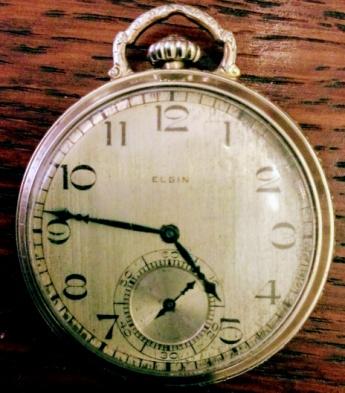
I tried on two continents to get my Grandfather Gottschalk’s pocket watch fixed.  No one in the US would do it. “Buy another one!” No one in the Netherlands would do it, not even the Polish fellow, who works for the watch repair shop in Badhoevedorp.  So, I carried it to Zaporozhye, Ukraine!  My good friend, Vadim Biriukov, helped me find a wonderful watch repair person.


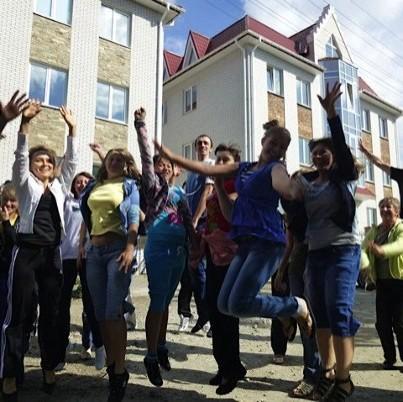
C:\Users\phil\Documents\UKR\ZBCS to Watchmaker map close up.png                                C:\Users\phil\Pictures\UKR\ZBCS Students jumping 2012.jpg


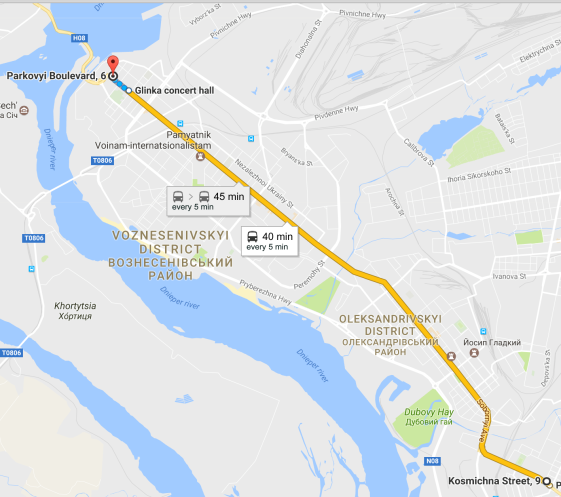
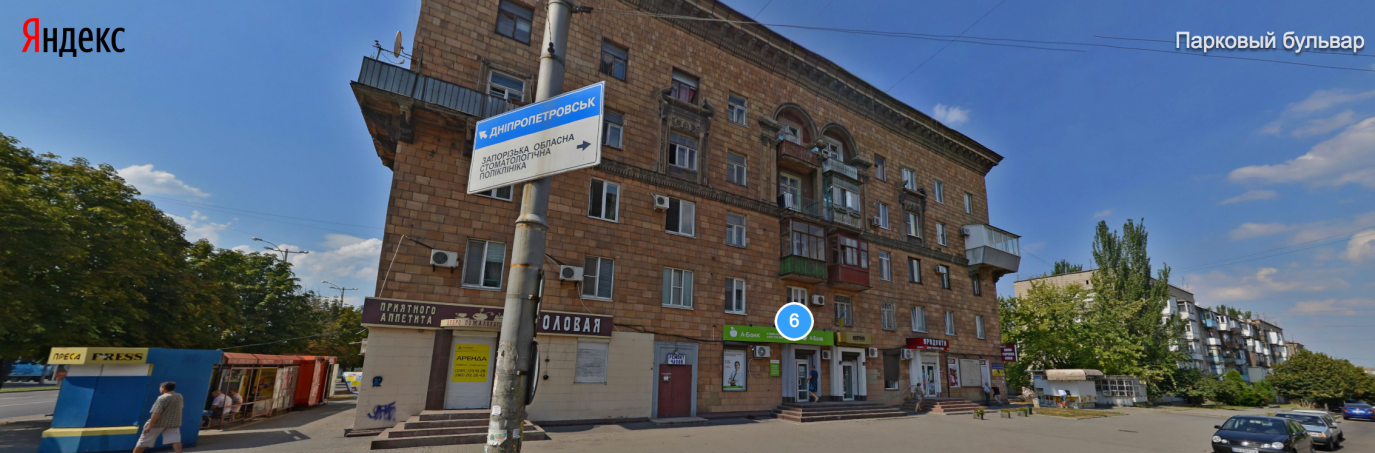
It was like old times!  We trundled down the central boulevard of Zaporozhye in a “marshroutka”, which is a private van running a specific route like a bus. However, it costs about twice as much as the public trolley bus. The avenue was called Lenin Boulevard (Leninskyi Prospekt) when I first went to Zaporozhye.


C:\Users\phil\Documents\UKR\Parkovyi bul'var 6 remont casov without map corner.png


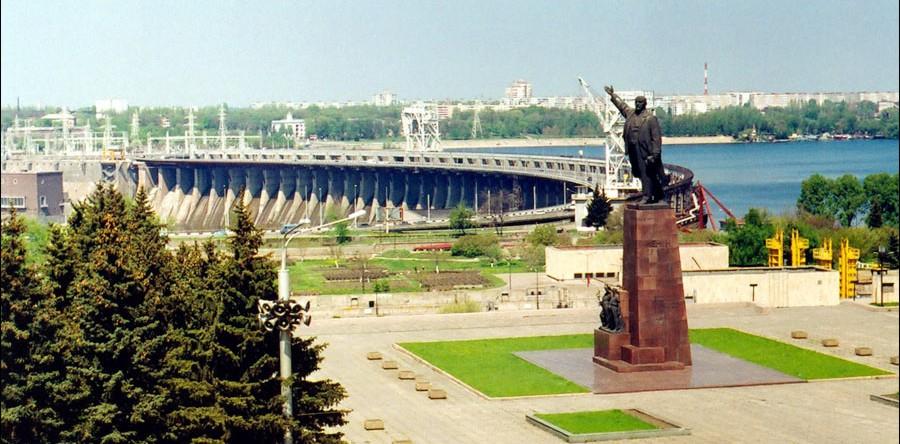
After about forty minutes of the teeth rattling ride, we had gone from the east of Zaporozhye, the Kosmicheskaia region (Cosmic neighborhood), where the football stadium is, where ZBCS is to the far west end, where the statue of Lenin used to be.  


C:\Users\phil\Pictures\UKR\zaporozhye-Lenin.jpg


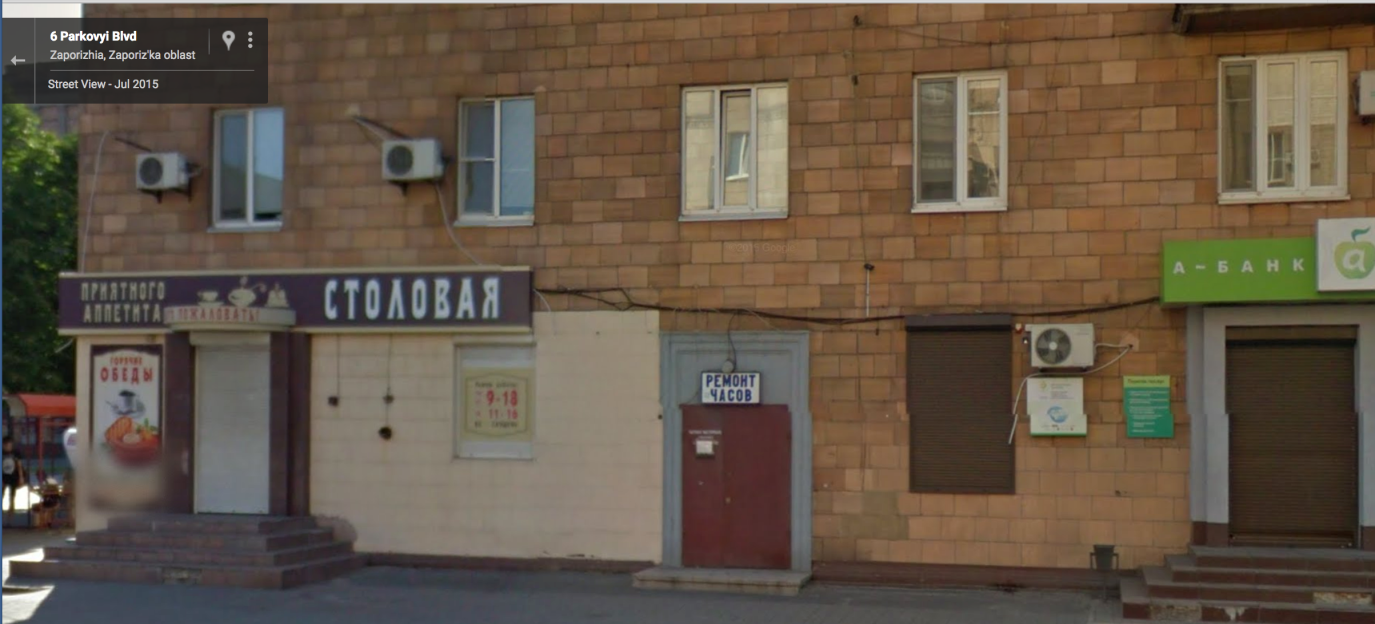
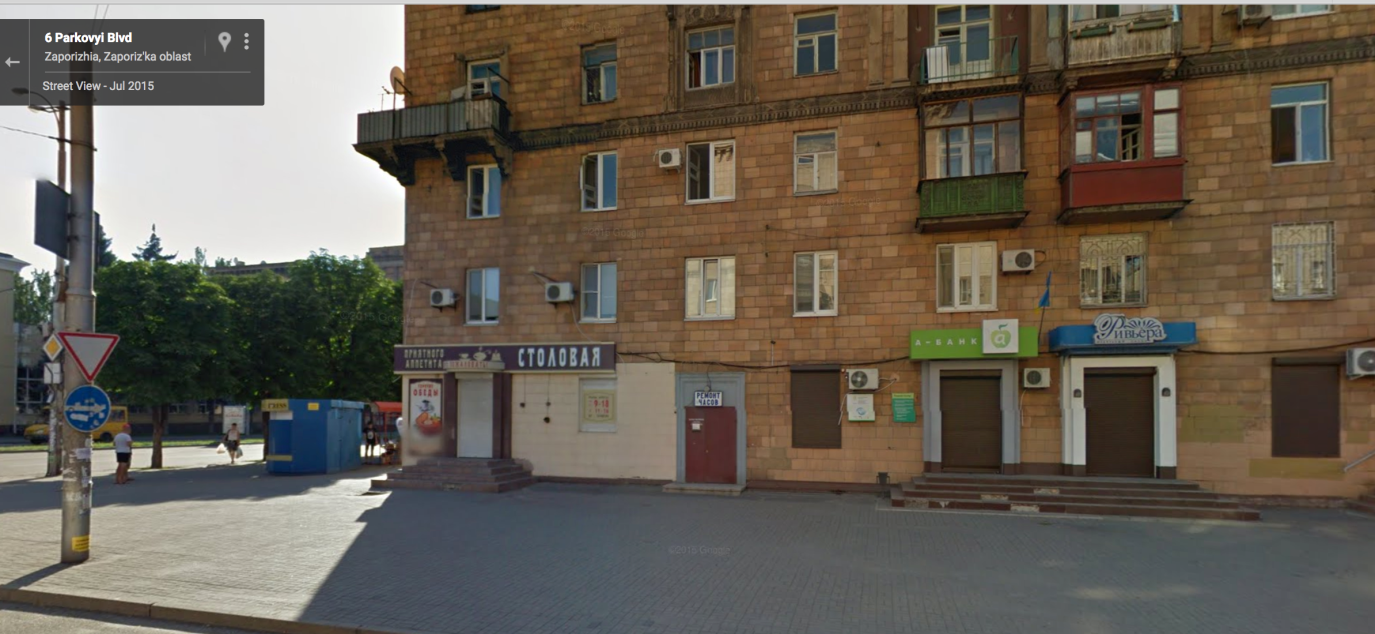
It was such a typical experience of Eastern Europe for me. There was a flashy store of some sort on the corner.  On the side of the building off the main street was another larger shop.  Nestled in between them was a set of double doors painted grey (I think or it could have been green).  The sign was simple two words: Repair of watches.  (In Russian, it’s two words.) There was a second set of double doors inside the first set.  


C:\Users\phil\Documents\UKR\Gmaps 6 Parkovyi blvd remon chasov.png


There was just space to stand inside.  There was a counter about chest high with a glass barrier another six inches above it.  The glass barrier was lined with clocks of all sorts.  On the walls behind the counter there were a variety of larger wall clocks.


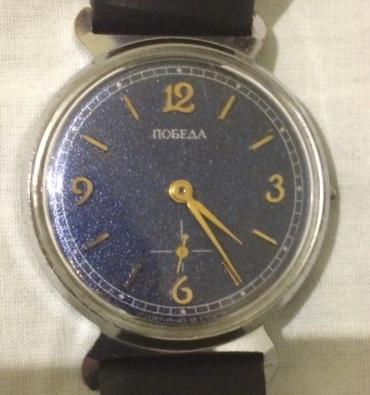
Also behind the counter was a woman of a certain age.  She had dyed her hair black and it was curled.  She was examining a watch through her jeweler’s eye glass when we entered.  She looked up very businesslike and asked what we needed.  My friend, Vadim, explained the two watches for repair: my old Pobeda wrist watch needed a new stem and my grandfather’s pocket watch.


C:\Users\phil\Documents\UKR\Pobeda wrist watch.jpg  https://media-cdn.tripadvisor.com/media/photo-s/02/1e/d9/f3/tsum.jpg


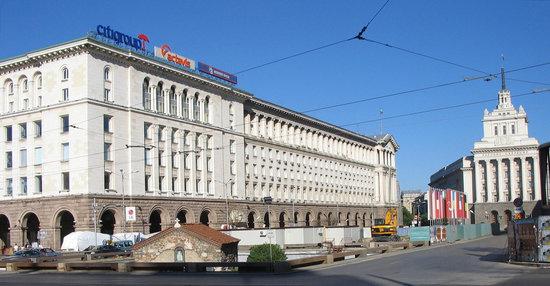
Pobeda wristwatch         Central Universal Department Store, Sofia, Bulgaria


Pobeda means victory in Russian, and this brand was the common man’s watch during the Soviet era.  I bought it in the Centralnii Universalnii Magazin (TZUM) [Central Universal Department store) in Sofia, Bulgaria, back in 1989 or 1990 during the Soviet period).


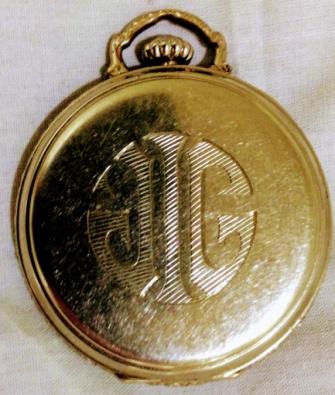
The pocket watch was given to my Grandfather Gottschalk, when he retired from J&L Steel (I think, Mum correct me if I’m wrong).  The case is steel with his initials JIG engraved on the back.  My father gave the watch to our son, John, because our John’s initials are the same.


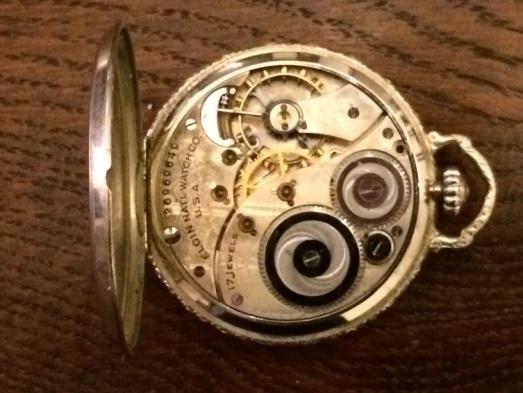
My father explained to me that a watch maker in Pittsburgh told him that someone had stolen the 17 jewels from the mechanism, and so was unrepairable.  I never did ask the watch repair woman in Zaporozhye if that was true.


In any event, she looked at the Pobeda wristwatch.  “No problem. 200 Hrynia” (about seven dollars).  She examined the pocket watch.  “Yes, I can fix it, but it will cost more, 380 Hryvnia, and I can’t finish it till Friday.”  Vadim said, “He must have it Thursday afternoon.” (Linda and I were leaving on Friday AM.)  The woman agreed, and we paid a deposit of 300 Hryvnia. (about 12 dollars). I left elated that the pocket watch could be repaired.


C:\Users\phil\Documents\UKR\Gmaps full shot 6 Parkovyi Blvd Remont chasov.png


Vadim explained to me that this woman had been the head of a watch factory.  However, now the factory was closed.  (Who wants Soviet era wind-up watches?)  Somehow this woman epitomized Eastern Europe for me, and to some degree Ukrainians.  There was fighting, a low-level, never ending war, going on only 250 km away, but she maintained her dignity.  She was an experienced craftsman and she was proud of her work. She was also too proud to take advantage of a foreigner.

So, though I searched on two continents for a repair person, I found her in Zaporozhye!  Now on the next trip I’ll take my father-in-law’s wristwatch!

Saturday, March 4, 2017

Double Tap

Those familiar with zombie movies will get the immediate reference of the title.  In the movie, Zombieland, Zombie hunter, Tallahassee, played by Woody Harrelson, says “You gotta do a double tap! If you don’t, they get up and bite ya!”


When shot in the chest with a sawed off shot gun, Zombies may fall to the ground. But if you don’t take the time to put one good blast in their heads, they will rise up and bite you from behind… or in the behind.


Our powder room toilet tank has a push button, which needs a double tap every time you flush.  If you flush just pushing it hard once, the plunger in the tank sticks. Then it continues running just a little bit until the next time you open the lid… to discover it’s still running.  In a country where water is desalinated from sea water, this is tantamount to a grievous sin.  Aside from the theological state of the affair, it’s expensive.  Letting water run is very costly.

We also have a toilet in our bathroom upstairs.  Just before the company, which owned the house when we started to rent it, sold the house to us, they sent a bunch of workmen and painters around to fix and paint things.  A plumber put a new tank above our old toilet.  Too bad for him he dropped the old throne on the tile floor and it broke into a million shards (no joke!).  So, he had to replace the throne too.

The new tank on the bathroom toilet is actually about the cheapest tank you can buy at the hardware store.  It has, though, a two stage push button mechanism.  When you push the front button, the water starts to flush.  If you push the second button, which says STOP, it stops the flow of water, saving water.


We had two German girls, who rented a room from us one year.  They were exchange students.  They seemed to do nothing, but drink and evacuate their bladders.  They were hard on the poor, cheap toilet.  They managed to bang on the flush button so hard and so often, the water ran constantly. The plunger inside just wouldn’t seat and stop the flow of water.

It took me a year to get up the courage to try and fix it.  I managed somehow to turn some screw the right way and go it to actually stop running.  The downside is that it takes a half an hour now to fill…

However, it also still needs a double tap… Sometimes the STOP button gets stuck and then the water… flows endlessly, until someone comes in and notices it.


I won’t do a Žižekian analysis of toilet tanks, as he did of toilet bowls, but we do have German Observation Deck toilets.  So, you can tell if you’re healthy or not (or whether a Zombie got you when you weren’t looking).


When I was a kid I would visit with my Grandmother Gottschalk, Bertha Jane Gottschalk (nee Simmons).  Grandma was a force of nature.  She was one of the original women’s libbers, though she didn’t know it, I think.  Grandma was a Second Grade Elementary School teacher for 50 years, really I’m not kidding 50 years.

I loved Grandma and Grandma loved me, but she was always fierce.  She has a “look” of disdain and disappointment that could freeze the seven year old heart.

Despite her gruff exterior, she had a heart of gold.  Many of her former students continued to write to her even into her retirement.  They loved her.

Still Grandma was “old school”.  She took no prisoners.  She had a right way for everything.

She was known (I witnessed it) to say to the sports announcer of the New York Mets (of course she was watching TV and talking to the screen), “I taught you better than that! Between you and I! Imagine!”  There was no slang or bad grammar in Grandma’s house.  Our favorite game (at least mine) was some version of Scrabble.  

Grandma used to take us to town to shop or to church or to the museum on the “street car” (tram) or by bus.  Before we left she would always say, “Did you go to the bathroom?” Of course, I hadn’t. So, I’d go up the stairs to the bathroom. (Grandma wasn’t having any extra money spent to put in a second powder room on the ground floor.) After I was about half way down the stairs, she would ask, “Did you ‘jiggle’ the handle?” (That is, did I shake the handle of the toilet to make sure the plunger had seated, and the water had stopped running.


Grandma was both a first wave feminist and a Depression Era survivor.  There was no waste in Grandma’s house.  She was not about to pay for water running pointlessly.  She was also not going to waste money on a plumber, who would come and charge a lot of money, when the result would be that the plunger would still stick.  And so, you had to “jiggle” the handle.

So, “double tapping” the button on our powder room toilet is second nature to me.  It’s part of life.  Old things are quirky and you learn to deal with it.  You humor old things so that they do what they should.

Not that I am an old thing, but I hope that people will “double tap” me… That didn’t come out right. I mean humor me and put up with me.

At least I didn’t do a Žižekian phenomenological analysis of excrement! ;-) Beware that if you do look up Žižek’s phenomenological analysis of excrement, he is a European, who has no problem with saying the “S” word.  Europeans, even godly Dutch people, have no problem with say the “S” word.  It’s like Americans saying manure.